Frank Lloyd Wright: Pioneer of Organic Architecture
by David Fox
Over a career spanning more than seven decades, Frank Lloyd Wright designed over 1,000 structures — and roughly 500 of them were actually built, making him one of the most prolific architects in recorded history. His philosophy of Frank Lloyd Wright organic architecture fundamentally reshaped how designers, builders, and homeowners think about the relationship between buildings and their natural surroundings. From the cantilevered terraces of Fallingwater to the spiraling ramps of the Guggenheim Museum, Wright's body of work remains a touchstone for anyone interested in architecture as both art form and lived experience. His influence extends far beyond the structures themselves — reaching into urban planning, interior design, and the broader cultural conversation about how humans inhabit space.
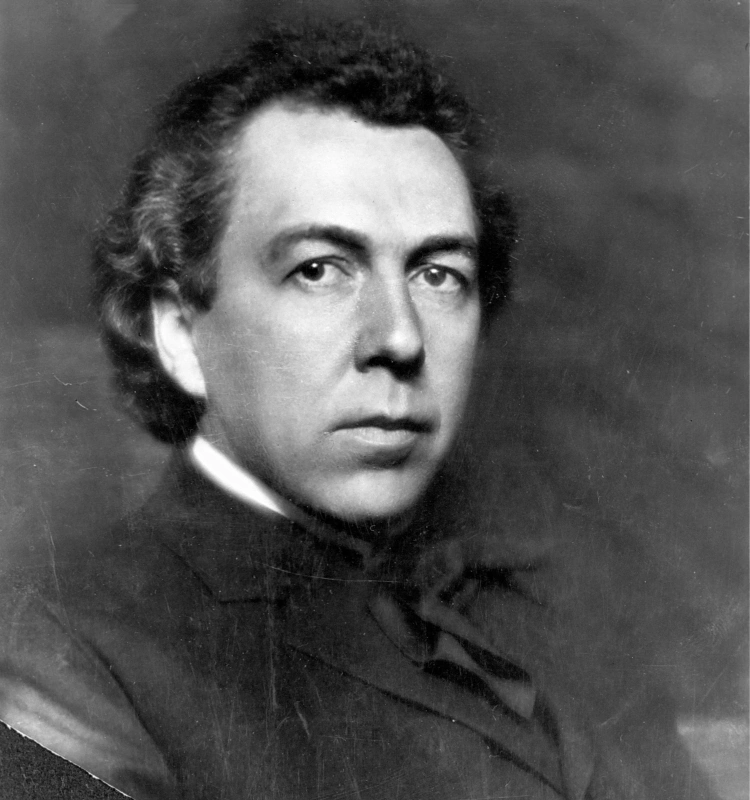
Wright's career began in the 1880s and continued until his death in 1959, a period that witnessed two world wars, the rise of the automobile, and the birth of suburban America. Throughout these seismic shifts, he maintained an unwavering commitment to the idea that architecture should grow from its site the way a plant grows from the soil. That conviction — sometimes called "organic architecture" — was not merely an aesthetic preference. It was a comprehensive worldview that dictated everything from the choice of building materials to the placement of furniture.
What makes Wright's legacy particularly relevant today is the way his principles anticipate contemporary concerns about sustainability, biophilic design, and the psychological effects of built environments. Architects and designers continue to cite his work as a foundational reference point, even as new technologies and materials open possibilities he never could have imagined.
Contents
- Common Myths About Frank Lloyd Wright's Design Philosophy
- Where Organic Architecture Principles Apply Today
- Preserving Wright's Buildings: Ongoing Structural Challenges
- Wright vs. His Contemporaries: A Design Comparison
- When Organic Architecture Works — and When It Doesn't
- Landmark Projects That Defined the Movement
- The Lasting Influence on Contemporary Architecture
- Frequently Asked Questions
- Key Takeaways
Common Myths About Frank Lloyd Wright's Design Philosophy
Despite being one of the most studied architects in history, Wright's ideas are frequently oversimplified or misrepresented. Several persistent myths continue to circulate among architecture enthusiasts and the general public alike.
The "Nature Worship" Misconception
One of the most common misunderstandings about Frank Lloyd Wright organic architecture is that it simply means "building things that look like nature." In reality, Wright's organic philosophy was far more nuanced:
- Integration, not imitation — Wright never aimed to make buildings resemble trees or rocks. He sought to create structures that belonged to their sites as naturally as any geological formation.
- Material honesty was central — stone should look like stone, wood should look like wood, and concrete should not pretend to be something else.
- The relationship between interior and exterior spaces mattered as much as the exterior form itself.
- Wright viewed the building, its furnishings, and its landscape as a single unified composition.
This distinction matters because it separates Wright from later movements — such as certain strains of biomimicry — that prioritize visual resemblance to natural forms. Wright's approach was structural and philosophical, not merely decorative. His work shares more DNA with certain principles found in the rise of modern art than many casual observers might expect.
The Affordability Myth
Another persistent myth holds that Wright designed exclusively for the wealthy. While projects like Fallingwater and Taliesin certainly served affluent clients, Wright spent significant effort on his Usonian houses — modest, single-story homes designed for middle-class American families. These homes, built from the mid-1930s onward, featured simplified construction methods, radiant floor heating, and open floor plans that eliminated formal dining rooms and servants' quarters.
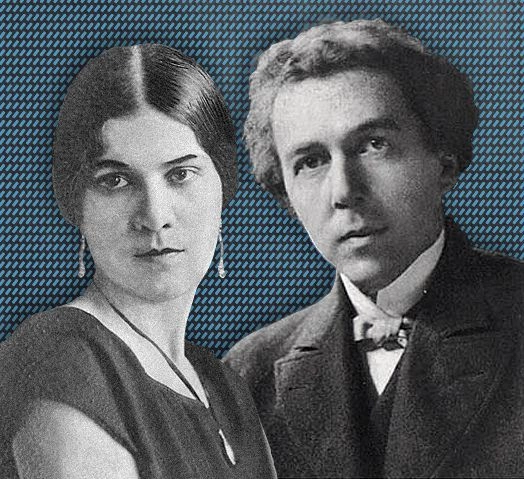
The Usonian concept was Wright's answer to the question of democratizing good design. Some were built for as little as $5,500 in their era — roughly equivalent to a modest home price at the time. Not all stayed within budget, but the intent was genuine.
Where Organic Architecture Principles Apply Today
Wright's organic principles have found applications far beyond the residential projects most commonly associated with his name. The core ideas — site-specific design, material honesty, spatial flow, and environmental integration — translate across building types and scales.
Residential Design
In residential architecture, organic principles manifest in several practical ways:
- Open floor plans that allow spaces to flow into one another, reducing the sense of confinement
- Large windows and clerestories positioned to maximize natural light while maintaining privacy
- Use of local materials that connect the home visually to its surrounding landscape
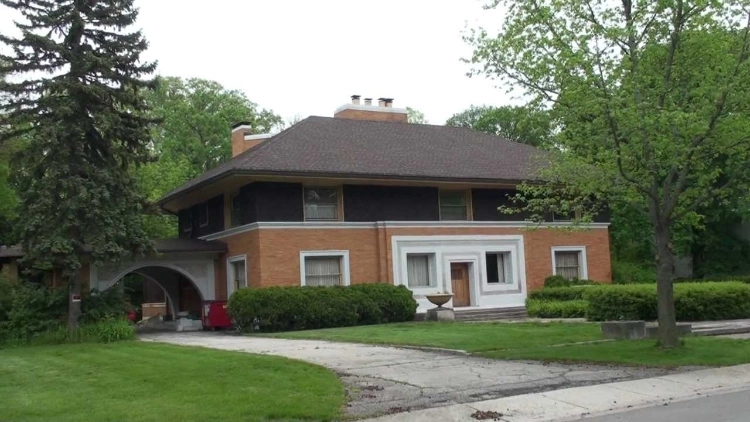
- Horizontal lines that echo the topography of the building site, particularly on flat or gently rolling terrain
- Built-in furniture that reduces clutter and reinforces the architectural concept
Commercial and Public Buildings
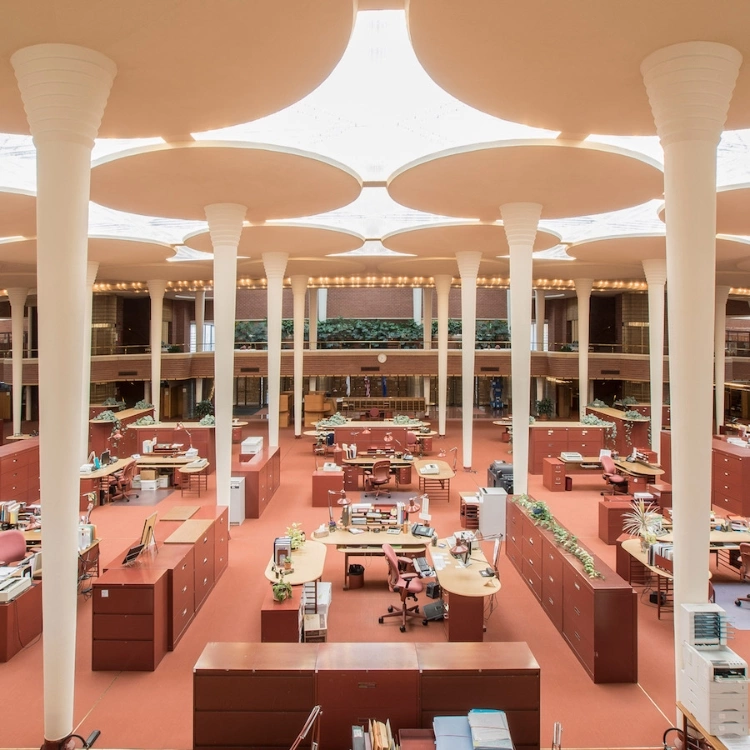
Wright's influence on commercial architecture is perhaps best illustrated by the Johnson Wax Headquarters in Racine, Wisconsin. The building's dendriform columns — designed to resemble lily pads — created a workspace that felt open and uplifting rather than oppressive. Contemporary office designers frequently cite this project when arguing for biophilic elements in workplace design.
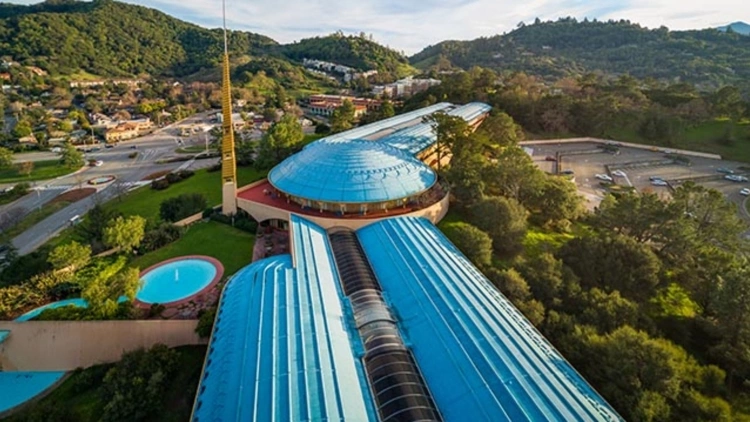
Public buildings like the Marin County Civic Center in California demonstrate how organic architecture can scale to institutional projects. The building stretches across two hills rather than sitting atop one, allowing the landscape to pass through the structure rather than being displaced by it.
Preserving Wright's Buildings: Ongoing Structural Challenges
For all their aesthetic brilliance, many of Wright's buildings have presented serious preservation challenges. The same design boldness that made them iconic also created vulnerabilities that conservators continue to address.
Water Infiltration and Cantilevers
Fallingwater, arguably Wright's most famous residential project, has required extensive structural remediation. The cantilevered terraces began deflecting almost immediately after construction, and water infiltration has been a persistent concern. The Western Pennsylvania Conservancy, which manages the property, invested over $11 million in structural repairs between the late 1990s and mid-2000s.
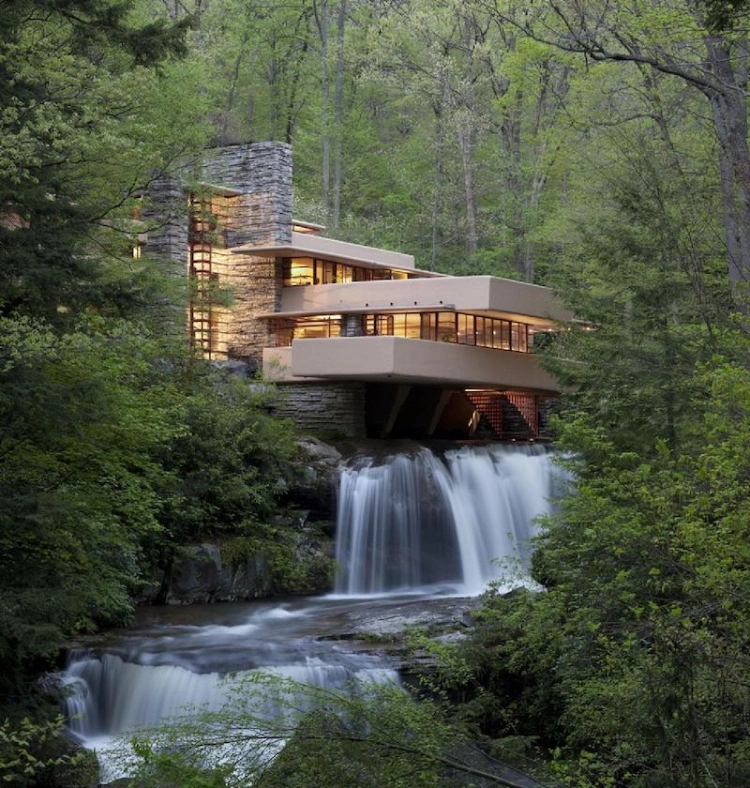
Wright's cantilevers pushed engineering limits of their era — preservation teams today must balance structural reinforcement with maintaining the original design intent.
Material Degradation
Wright frequently experimented with unconventional construction methods. His textile block houses in Los Angeles used patterned concrete blocks that, over time, have proven susceptible to moisture damage and rebar corrosion. Key preservation issues include:
- Flat roofs that lack adequate drainage, leading to pooling and leaks
- Custom-mixed concrete that has deteriorated at rates different from standard formulations
- Radiant floor heating systems embedded in concrete slabs, making repairs invasive and expensive
- Custom-designed windows and doors for which replacement parts do not exist commercially
According to the Frank Lloyd Wright Wikipedia entry, eight of his buildings were collectively inscribed as a UNESCO World Heritage Site — a designation that brings both international recognition and additional preservation obligations.
Wright vs. His Contemporaries: A Design Comparison
Understanding Frank Lloyd Wright organic architecture becomes clearer when measured against the philosophies of his most prominent contemporaries. While all three figures shaped modern architecture, their approaches differed fundamentally.
| Characteristic | Frank Lloyd Wright | Le Corbusier | Mies van der Rohe |
|---|---|---|---|
| Core Philosophy | Organic — building as extension of site | Machine for living — function dictates form | Less is more — universal space |
| Relationship to Site | Integrated with landscape | Elevated above landscape (pilotis) | Neutral container on any site |
| Preferred Materials | Local stone, wood, concrete | Reinforced concrete, glass | Steel, glass, travertine |
| Spatial Approach | Flowing, compressed-to-released | Free plan, open floor plates | Universal open space |
| Ornament | Integral — grows from structure | Rejected entirely | Refined detail as ornament |
| Typical Roof Form | Low-pitched, cantilevered overhangs | Flat roof terrace (roof garden) | Flat, minimal expression |
| Furniture Design | Custom built-ins unified with building | Tubular steel, mass-produced | Elegant minimal pieces (Barcelona chair) |
| Legacy Buildings | Fallingwater, Guggenheim | Villa Savoye, Chandigarh | Farnsworth House, Seagram Building |
Le Corbusier's Machine Aesthetic
Where Wright sought harmony with the landscape, Le Corbusier treated architecture as an industrial product. His "Five Points of Architecture" — pilotis, free plan, free facade, ribbon windows, and roof garden — were conceived as universal principles applicable anywhere. Wright viewed this approach as fundamentally misguided, arguing that architecture divorced from its site was no architecture at all.
The philosophical divide also extended to questions about art and expression. Just as movements like De Stijl championed geometric abstraction in painting and design, Le Corbusier embraced a similar machine-age purity — while Wright drew inspiration from natural patterns and the prairie landscape.
Mies van der Rohe's Minimalism
Mies van der Rohe pursued what might be called "universal space" — architecture reduced to its most essential structural elements. His glass-and-steel boxes were designed to work on almost any site, a direct contrast to Wright's insistence on site-specificity. Both architects valued material honesty, but they expressed it differently. Mies celebrated the precision of industrial steel; Wright celebrated the texture of quarried stone.
When Organic Architecture Works — and When It Doesn't
Organic architecture is not a universal solution. Its effectiveness depends heavily on context, budget, and project goals. A clear-eyed assessment of its strengths and limitations helps architects and clients make informed decisions.
Ideal Conditions
Organic design principles tend to excel in the following scenarios:
- Sites with strong natural features — slopes, rock outcroppings, mature trees, water features — that provide design opportunities
- Projects where the client values long-term livability over short-term cost efficiency
- Rural and suburban settings where buildings can engage directly with the landscape
- Renovation projects seeking to reconnect existing structures with their surroundings
- Cultural and institutional buildings where the experience of moving through space is paramount
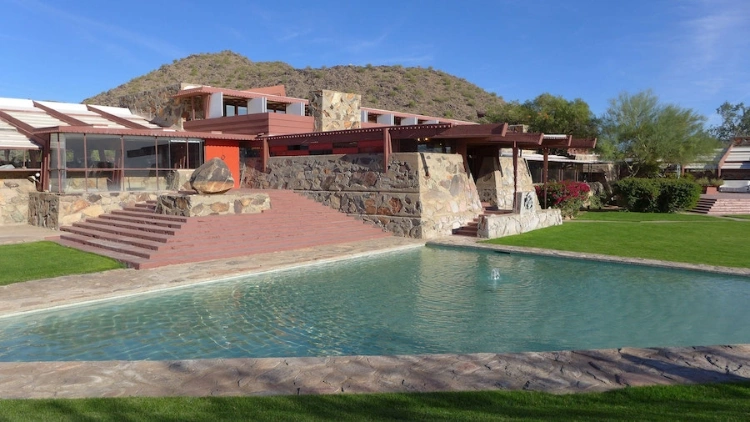
Taliesin West in Scottsdale, Arizona, exemplifies the ideal application. Wright used desert rubblestone, redwood, and canvas to create a compound that appears to emerge from the Sonoran Desert itself. The angled walls and low profiles echo the surrounding mountain forms.
Practical Limitations
Organic architecture faces significant challenges in certain contexts:
- Dense urban environments where site constraints leave little room for landscape integration
- Tight budgets that cannot accommodate custom materials or site-specific engineering
- Projects requiring rapid construction timelines, since organic design typically demands longer design and build phases
- Speculative development where the end user's preferences are unknown at design time
Wright himself acknowledged these tensions. His Broadacre City concept — an idealized vision of decentralized American living — assumed abundant land, a premise that sits uncomfortably alongside contemporary density targets and anti-sprawl policies.
Landmark Projects That Defined the Movement
Wright's career can be mapped through a series of landmark projects, each representing an evolution in his thinking about organic architecture. These buildings serve as case studies in how a single philosophical commitment can produce dramatically different formal results.
The Prairie Houses
Wright's Prairie houses, built primarily between 1900 and 1917, established many of the principles that would define his career. The Robie House in Chicago, completed in 1910, is widely regarded as the finest example:
- Dramatic horizontal lines emphasize the flatness of the Midwestern landscape
- Cantilevered roof overhangs extend up to 6 meters beyond supporting walls
- An open floor plan connects living and dining areas without partition walls
- Art glass windows filter light while maintaining privacy from the street
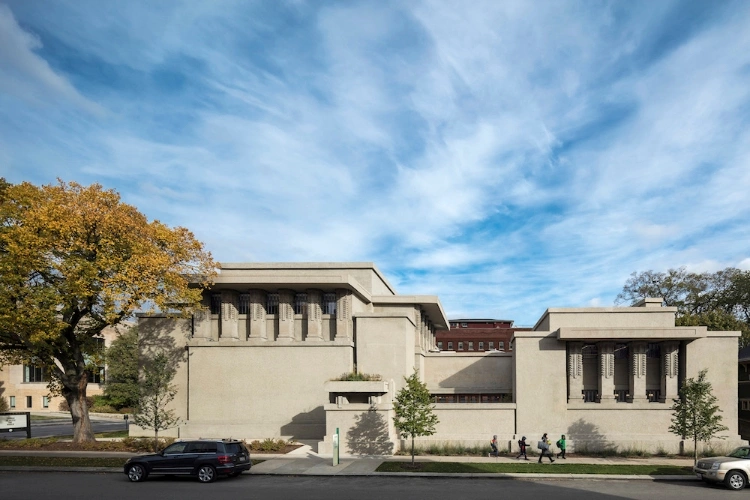
The Prairie style also influenced Wright's approach to sacred architecture. Unity Temple in Oak Park, Illinois, built between 1905 and 1908, used poured-in-place concrete — an industrial material — to create a space of extraordinary spiritual calm.
Later Masterworks
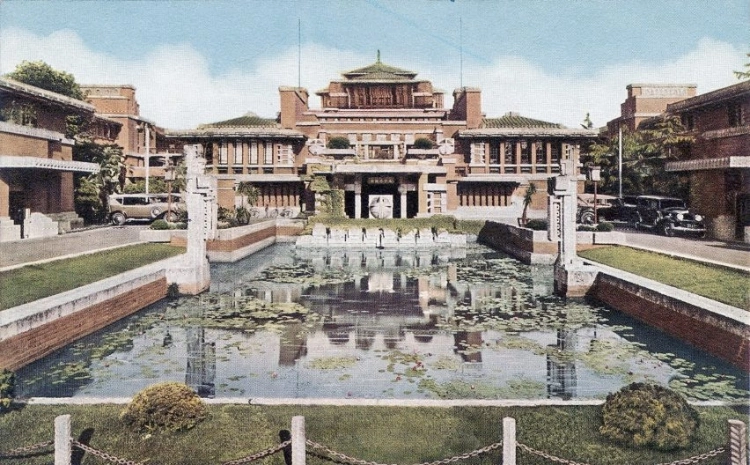
Wright's later career produced some of his most ambitious projects. The Imperial Hotel in Tokyo, completed in 1923, famously survived the Great Kanto Earthquake — a fact Wright cited as validation of his structural approach. The building's floating foundation, designed to rest on soft soil like a ship on water, proved remarkably effective.
The Solomon R. Guggenheim Museum in New York City, completed in 1959 — the year of Wright's death — represents perhaps the most radical expression of his organic philosophy. The continuous spiral ramp eliminates the conventional gallery room entirely, replacing it with a single flowing space that Wright compared to an "unbroken wave."
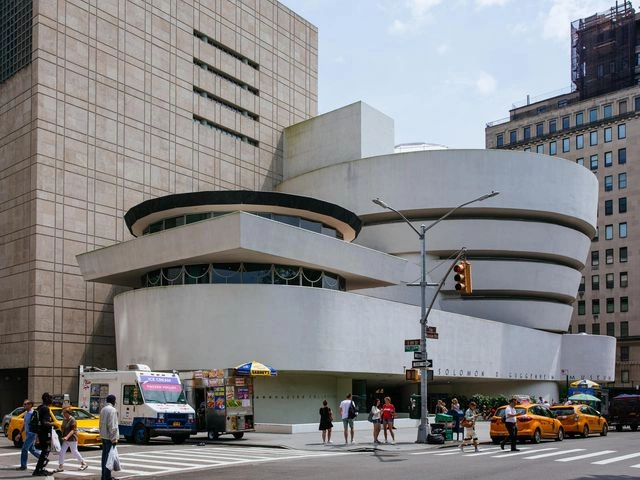
The Guggenheim also illustrates how Wright's work intersected with broader artistic movements. At a time when Robert Rauschenberg was challenging gallery conventions with his combines and assemblages, Wright was challenging the gallery space itself — arguing that the architecture should be as much a part of the artistic experience as the works on display.
The Lasting Influence on Contemporary Architecture
Frank Lloyd Wright organic architecture did not end with Wright. Its principles have been absorbed, adapted, and reinterpreted by successive generations of architects working in vastly different contexts and with different technologies.
Sustainability and Biophilic Design
The contemporary sustainability movement owes a considerable debt to Wright's principles, even when practitioners do not cite him directly. Key areas of overlap include:
- Passive solar design — Wright's use of roof overhangs to shade summer sun while admitting winter light anticipates modern passive solar strategies
- Local material sourcing — reducing transportation costs and embodied carbon while connecting buildings to regional identity
- Natural ventilation — Wright's designs often incorporated operable windows and cross-ventilation strategies that reduce reliance on mechanical cooling
- Biophilic elements — the integration of water features, natural light, and views of vegetation into architectural design
Firms such as Kengo Kuma and Associates in Japan, Olson Kundig in the Pacific Northwest, and Studio Gang in Chicago all work within traditions that trace, in part, back to Wright's organic philosophy. Their approaches differ significantly from one another, but all share a commitment to site-responsive design that treats landscape as a partner rather than a blank canvas.
Architectural Education
Wright's educational legacy continues through the School of Architecture at Taliesin (formerly the Frank Lloyd Wright School of Architecture), which operated until its closure and subsequent revival. The school's "learning by doing" approach — where students participated in the construction and maintenance of buildings at Taliesin and Taliesin West — represented a radical alternative to conventional architectural education.
This hands-on philosophy has influenced contemporary programs that emphasize design-build pedagogy, including Auburn University's Rural Studio and the Yale Building Project. The idea that architects should understand construction at a physical level, not merely at a theoretical one, can be traced directly to Wright's educational vision.
Frequently Asked Questions
What does "organic architecture" actually mean?
Organic architecture, as Frank Lloyd Wright defined it, refers to design that integrates a building with its natural environment so that the structure appears to grow from its site. This includes using local materials, responding to topography and climate, and creating fluid interior spaces that connect seamlessly to the outdoors. It is not about making buildings look like natural objects.
Which Frank Lloyd Wright building best exemplifies organic architecture?
Fallingwater in Mill Run, Pennsylvania, is widely considered the purest expression of Wright's organic philosophy. The house is built directly over a waterfall, with cantilevered concrete terraces that extend over the stream below. The stone walls are constructed from local sandstone quarried on the property, and the interior spaces open directly to the surrounding forest.
How many Frank Lloyd Wright buildings still exist?
Approximately 400 Wright-designed structures survive, spread across the United States and a handful of international locations. Eight of these were collectively designated a UNESCO World Heritage Site. Many are open to the public as museums or house museums, while others remain private residences.
Were Frank Lloyd Wright's buildings structurally sound?
Wright's buildings were innovative but sometimes pushed structural limits beyond what the engineering of his era could reliably support. Fallingwater's cantilevers deflected significantly, and many of his flat roofs developed leak problems. However, buildings like the Imperial Hotel in Tokyo — which survived a major earthquake — demonstrated genuine structural ingenuity. Preservation efforts have since addressed many of the original structural concerns.
What are Usonian houses?
Usonian houses were Wright's attempt to design affordable, beautiful homes for middle-class American families. Built primarily from the mid-1930s through the 1950s, they featured single-story plans, radiant floor heating, carports instead of garages, and open kitchens (which Wright called "workspaces"). Around 60 Usonian homes were built during Wright's lifetime.
How did Wright influence modern sustainable architecture?
Wright's use of passive solar strategies, natural ventilation, local materials, and site-responsive design anticipated many principles now central to green building certifications like LEED. His emphasis on connecting buildings to their natural surroundings also prefigures the contemporary biophilic design movement, which seeks to improve occupant health through exposure to natural elements.
What is the difference between Wright's Prairie style and his later work?
The Prairie style, developed between roughly 1900 and 1917, emphasized horizontal lines, low-pitched roofs, and open floor plans suited to the flat Midwestern landscape. Wright's later work expanded these principles to diverse climates and building types — from the desert-adapted Taliesin West to the urban Guggenheim Museum — while maintaining the core organic philosophy of integrating building and site.
Can organic architecture principles be applied to modern urban buildings?
Organic principles can be adapted for urban contexts, though with significant modifications. Contemporary architects apply Wright's ideas through green roofs, living walls, natural light optimization, and materials sourced from regional suppliers. Dense urban sites limit some strategies — such as extensive landscape integration — but the underlying philosophy of connecting occupants to natural systems remains applicable even in high-rise construction.
Key Takeaways
- Frank Lloyd Wright organic architecture is defined by integration with the natural site, material honesty, and flowing interior spaces — not by making buildings look like natural objects.
- Wright's legacy encompasses over 500 built structures ranging from modest Usonian homes to the Guggenheim Museum, with eight collectively recognized as a UNESCO World Heritage Site.
- Preservation of Wright's buildings remains an active challenge, as his experimental structural techniques often pushed beyond the reliable engineering capacities of his time.
- Contemporary sustainable architecture, biophilic design, and design-build education all draw directly on principles Wright established over the course of his seven-decade career.


About David Fox
David Fox is an artist and writer whose work spans painting, photography, and art criticism. He created davidcharlesfox.com as a platform for exploring the history, theory, and practice of visual art — covering everything from Renaissance masters and modernist movements to contemporary works and the cultural context that shapes how art is made and received. At the site, he covers art history, architecture, anime art and culture, collecting guidance, and profiles of influential artists across centuries and movements.
Now get FREE Gifts. Or latest Free phones here.
Disable Ad block to reveal all the secrets. Once done, hit a button below