Best Chair For Video Editing: Reviews, Buying Guide, and FAQs 2026
by David Fox
Which chair actually holds up through a 10-hour video editing marathon — and which ones fall apart by hour three? If you're cutting footage in Premiere Pro or DaVinci Resolve all day, your chair matters more than your monitor. After evaluating seven of the top contenders in 2026, the Herman Miller Aeron remains our top overall pick for video editors who need rock-solid lumbar support and a 12-year warranty to back it up.
Video editing is uniquely demanding on your body. You're not just sitting — you're leaning forward to scrub timelines, reclining to review playback, and shifting constantly between your keyboard, mouse, and control surface. A good editing chair needs to move with you, support your lower back in multiple positions, and keep you cool during those long render-and-review sessions. The wrong chair leads to back pain, fatigue, and — frankly — worse edits because you're distracted by discomfort.
We've tested chairs across every price point, from the budget-friendly Homall at under $200 to the premium Humanscale Freedom at over $1,000. Whether you're building a home editing suite or outfitting a post-production studio, this guide breaks down exactly what each chair does well, where it falls short, and which one fits your workflow. If you're also setting up a creative workspace, check out our best chairs for artists guide for additional seating options tailored to long creative sessions.

Contents
Top Rated Picks of 2026
- #PreviewProductRating
- Bestseller No. 1
 Rating:

- Bestseller No. 2
 Rating:
 - Bestseller No. 3
 Rating:
 - Bestseller No. 4
 Rating:
 - Bestseller No. 5
 Rating:
 - Bestseller No. 6
 Rating:
 - Bestseller No. 7
 Rating:
Full Product Breakdowns
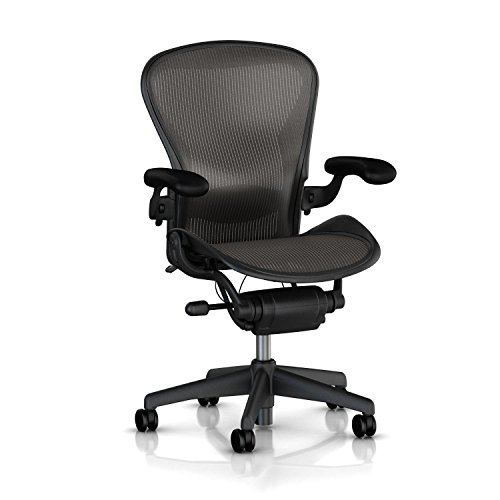
1. Herman Miller Aeron Executive Office Chair — Best Overall for Video Editors
The Herman Miller Aeron has been the gold standard in professional seating for over two decades, and the 2026 version with its stainless steel frame continues that legacy. For video editors, its PostureFit SL lumbar support is the standout feature — it cradles both your sacrum and lumbar spine simultaneously, which matters enormously when you're shifting between forward-leaning timeline scrubbing and reclined playback review. The pellicle mesh suspension distributes weight evenly and keeps you remarkably cool, even in a warm editing bay.
Build quality is exceptional. The stainless steel frame feels virtually indestructible, and the fully adjustable arms let you dial in the exact height and angle you need for your editing desk setup. The tension control and forward tilt options give you fine-grained posture control that cheaper chairs simply cannot match. This is a chair built for 12+ hour days — and the 12-year warranty proves Herman Miller stands behind that claim.
The Size B fits most users between 5'2" and 6'0". If you're outside that range, you'll want to look at the Size A or Size C variants. The open box pricing makes this premium chair more accessible, though it's still the most expensive option on our list.
Pros:
- Industry-leading PostureFit SL lumbar support adapts to forward and reclined positions
- Breathable pellicle mesh keeps you cool during marathon editing sessions
- 12-year warranty and 30-day money-back guarantee — best coverage on the list
- Fully adjustable arms, tension control, rear tilt lock, and forward tilt
- Stainless steel frame built to last well beyond a decade
Cons:
- Premium price point, even at open box pricing
- Size B won't fit users above 6'0" or below 5'2" — you'll need to order a different size
- No integrated headrest (available as a third-party add-on)
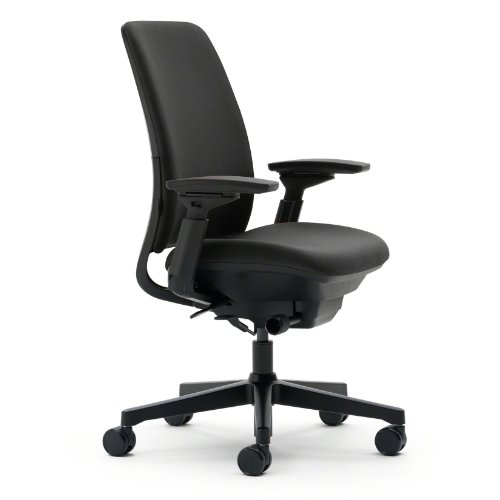
2. Steelcase Amia Office Chair — Best for All-Day Comfort
The Steelcase Amia takes a different approach to ergonomic support than the Aeron. Instead of mesh, it uses a flexible-edge seat with extra cushioning that eliminates pressure points behind your knees — a real benefit when you're sitting for 8 to 10 hours straight reviewing footage. The hidden LiveLumbar system moves with you dynamically, adjusting to your spine's position as you shift between tasks without requiring manual readjustment.
Steelcase's 4D arm support is a highlight for editors specifically. You can adjust height, width, pivot, and depth, which means you can position your arms perfectly whether you're using a mouse, keyboard, or Wacom tablet. The full recline range locks in the upright position too — handy when you need to sit up straight for color-critical work on a calibrated monitor.
The Buzz2 Black fabric is durable and professional-looking, though it doesn't breathe as well as mesh alternatives. If your editing room runs warm, you may notice more heat buildup compared to the Aeron or Branch. That said, the overall comfort package — seat cushioning, lumbar dynamics, arm adjustability — makes this one of the best chairs for editors who prioritize pure sitting comfort over airflow.
Pros:
- LiveLumbar system provides dynamic lower back support without manual adjustment
- Flexible seat edges and extra cushioning eliminate pressure points for 8-10 hour sessions
- 4D adjustable arms adapt perfectly to editing desk setups (mouse, keyboard, tablet)
- Full recline with upright lock position for detail-oriented editing work
Cons:
- Fabric seat traps more heat than mesh alternatives
- Heavier and bulkier than comparable ergonomic chairs — difficult to move between rooms
3. Humanscale Freedom Office Chair with Headrest — Best Self-Adjusting Design
The Humanscale Freedom takes a radically minimalist approach to ergonomics: the chair adjusts itself to you rather than the other way around. The pivoting backrest automatically adapts to your spine's changing needs as you recline, using a counterbalance mechanism based on your body weight. For video editors who constantly shift between leaning in to trim clips and leaning back to watch playback, this self-adjusting design means you're never fighting the chair.
The included headrest is a genuine differentiator. When you recline to review a rough cut or take a short break between renders, the headrest provides real neck support that most competitors lack at any price. The Fourtis fabric on the graphite frame looks sharp in a professional studio environment, and the standard height-adjustable Duron arms handle the basics well enough for most desk configurations.
The trade-off with the Freedom's philosophy is reduced manual control. If you're the type who likes to fine-tune every setting, you'll feel limited here. The carpet casters are a thoughtful inclusion — no need to buy aftermarket wheels — but if you're working on hard floors, you'll want to swap them out. The Freedom is also at the top of the price range, competing directly with the Aeron.
Pros:
- Self-adjusting backrest adapts to your movements automatically — zero knob-fiddling
- Integrated headrest provides genuine neck support for reclined review sessions
- Weight-sensitive recline mechanism works seamlessly across different body types
- Clean, professional design suits studio environments
Cons:
- Limited manual adjustability may frustrate users who want granular control
- Premium price comparable to the Herman Miller Aeron
- Carpet-only casters included — hard floor users need replacements
4. Branch Ergonomic Chair — Best Mid-Range Value
The Branch Ergonomic Chair hits a sweet spot that's rare in the office chair market: genuine ergonomic features at a mid-range price. With eight adjustment points covering recline, tilt tension, lumbar position, armrest placement, seat height, and more, it offers a level of customization you'd expect from chairs twice its cost. The breathable mesh backrest keeps airflow moving during long editing sessions, and the adjustable lumbar support lets you dial in exactly the right amount of lower back pressure.
For video editors building out a home studio on a budget, this is the chair to beat in 2026. The mesh back breathes nearly as well as the Aeron, the lumbar support is genuinely adjustable (not just a pillow strapped on), and the smooth-rolling wheels work well on both carpet and hard floors. Branch has built a solid reputation in the direct-to-consumer ergonomic space, and this chair reflects that commitment to quality without the brand tax of Steelcase or Herman Miller.
Where the Branch falls short is in the arm padding and seat depth adjustment. The armrests are functional but lack the plush cushioning of premium competitors, and there's no seat slide to fine-tune depth for taller users. If you're under 6'2", these are non-issues. If you're taller, consider the FLEXISPOT ErgoX-PRO instead. For everyone else, the Branch delivers an outstanding balance of ergonomic support, breathability, and value. If you're outfitting a broader creative space alongside your editing setup, our art buying guide covers gear across multiple creative categories.
Pros:
- Eight adjustment points offer premium-level customization at a mid-range price
- Breathable mesh backrest rivals higher-priced competitors for airflow
- Smooth-rolling wheels work on both carpet and hard floors out of the box
- Adjustable lumbar support is mechanical, not a removable pillow
Cons:
- Armrest padding is thinner than premium alternatives
- No seat depth adjustment — taller users (6'2"+) may feel cramped
5. FLEXISPOT ErgoX-PRO Ergonomic Office Chair — Best Feature-Loaded Option
The FLEXISPOT ErgoX-PRO is the Swiss Army knife of ergonomic chairs in 2026. Its headline feature is the 5D fully extendable lumbar support that adapts to your posture with more range of motion than any other chair on this list. Pair that with the 4D headrest, 7D linkage armrests, and a built-in footrest, and you're looking at a chair that covers every conceivable seating position — from upright editing to fully reclined break mode.
The AeroWeave 5.0 mesh seat option is the right choice for video editors. It provides excellent cooling airflow during long sessions, and the mesh tension is firm enough to support proper posture without feeling stiff. The alternative Cloudtech cushion is softer and more comfortable for casual use, but the mesh wins for all-day professional work. The 551-pound weight capacity makes this one of the most robust chairs available, built on a frame that can handle years of daily use.
Those 7D linkage armrests deserve special mention for editors. They move with your body — up, down, forward, back, in, out, and pivot — which means they track your arm position naturally as you reach for different parts of your desk. When you're switching between a keyboard, color grading panel, and audio mixer, that continuous arm support reduces shoulder fatigue significantly. The built-in footrest is a nice bonus for reclined review sessions, though it adds bulk to an already large chair.
Pros:
- 5D lumbar, 4D headrest, and 7D armrests provide the most adjustment options on this list
- AeroWeave 5.0 mesh seat offers premium airflow and firm ergonomic support
- 551-pound weight capacity and heavy-duty frame built for long-term durability
- Integrated footrest for reclined breaks between editing sessions
Cons:
- Large footprint — requires a spacious editing bay or office
- The sheer number of adjustments can be overwhelming during initial setup
- Heavier than most competitors, making it difficult to move
6. noblechairs Hero Gaming Chair — Best Gaming-Style Option for Editors
If you're a video editor who also games — or you simply prefer the high-back bucket seat design — the noblechairs Hero is the best gaming-style chair that actually delivers on ergonomic performance. Developed alongside esports professionals, it features a robust steel frame with cold-foam upholstery that provides firm, supportive cushioning without the cheap feel of most gaming chairs. The integrated adjustable lumbar support is built into the backrest itself, not a removable pillow that loses its shape after six months.
The PU faux leather is a step up from the bonded leather found on budget gaming chairs. It's more breathable, more durable, and easier to clean — practical advantages in a room where you might be eating lunch at your desk while reviewing dailies. The 4D armrests and rocking mechanism provide good adjustability, and the high backrest with side bolsters keeps you centered in the seat during long sessions.
The honest trade-off with any gaming chair, including this one, is heat. PU leather simply doesn't breathe like mesh. If your editing room lacks air conditioning, you'll feel the difference after a few hours compared to the Aeron or Branch. The aesthetic is also distinctly gaming — the racing-style design won't blend into a professional studio as seamlessly as the other options on this list. But if comfort, build quality, and that high-back support are your priorities, the Hero earns its name.
Pros:
- Steel frame and cold-foam upholstery provide firm, durable support
- Integrated adjustable lumbar support (not a removable pillow)
- High backrest with side bolsters keeps you centered during long sessions
- PU faux leather is easy to clean and more durable than bonded leather
Cons:
- PU leather retains more heat than mesh chairs — not ideal for warm rooms
- Gaming aesthetic may not suit professional studio environments
7. Homall Office Chair High Back — Best Budget Pick
The Homall Office Chair proves you don't need to spend $1,000+ to get decent ergonomic support for video editing. At a fraction of the cost of the premium options on this list, it delivers an ergonomic spine support system with PU leather upholstery and a double-padded seat that's genuinely comfortable for medium-length editing sessions of 4 to 6 hours. The 300-pound weight capacity and heavy-duty base inspire reasonable confidence in durability.
The padded armrests are a welcome touch at this price point — many budget chairs skip arm padding entirely. The 90° to 110° reclining range gives you enough tilt for quick breaks, and the 4-inch height adjustment range accommodates most standard desk heights. The 360° smooth-rolling nylon wheels work well on hard floors, though they can slide a bit too freely on some surfaces.
Let's be real about the limitations. This is a budget chair, and it behaves like one over time. The PU leather will show wear faster than the noblechairs Hero, the lumbar support is fixed rather than adjustable, and the foam cushioning compresses noticeably after 6 to 12 months of daily use. For freelance editors just starting out, or as a secondary chair in a multi-room setup, the Homall is a solid entry point. For full-time professionals editing 8+ hours daily, investing in the Branch or Steelcase Amia will save you money on replacements and chiropractor visits long-term.
Pros:
- Excellent value — delivers basic ergonomic features at a fraction of premium pricing
- Padded armrests and double-padded seat are above average for the budget category
- Simple assembly and straightforward height/recline adjustments
- Professional appearance that works in home offices and conference rooms
Cons:
- PU leather and foam degrade faster than premium materials — expect 1-2 year lifespan with heavy use
- Fixed lumbar support with no adjustment range
- Not suitable for 8+ hour daily editing sessions — comfort drops significantly after 5-6 hours
Choosing the Right Chair for Video Editing: A Buying Guide
Lumbar Support and Spinal Alignment
Lumbar support is the single most important feature in a video editing chair. When you're hunched over a timeline for hours, your lower spine takes the brunt of the abuse. Look for chairs with adjustable lumbar support — not a removable pillow, but a built-in mechanism you can position precisely against your lower back. The Herman Miller Aeron's PostureFit SL and Steelcase Amia's LiveLumbar system represent the gold standard here, supporting both your lumbar region and sacrum simultaneously. According to the Occupational Safety and Health Administration (OSHA), proper workstation ergonomics — including chair support — directly reduces the risk of musculoskeletal disorders in desk-bound workers.
Seat Material: Mesh vs. Foam vs. Leather
Your choice of seat material affects both comfort and temperature regulation:
- Mesh (Aeron, Branch, FLEXISPOT): Best airflow, stays cool in warm editing bays, distributes weight evenly. Firm feel that some find less comfortable initially.
- Foam cushion (Steelcase Amia, FLEXISPOT Cloudtech): Softer immediate comfort, better pressure distribution. Retains more heat and compresses over time.
- PU leather (noblechairs Hero, Homall): Easy to clean, professional look. Retains the most heat and may crack or peel with heavy use after 2-3 years.
For most video editors working 6+ hours daily, mesh is the practical winner. It maintains consistent support and temperature regulation year-round.
Armrest Adjustability
Video editors use a wider variety of input devices than typical office workers. You might be switching between a keyboard, mouse, Wacom pen tablet, color grading panel, and audio faders — sometimes in a single session. Armrests with at least 3D adjustment (height, width, pivot) keep your arms properly supported across these different reaching positions. The FLEXISPOT ErgoX-PRO's 7D linkage armrests lead the pack here, followed by the Steelcase Amia's 4D arms. Fixed armrests or basic height-only adjustment (like the Homall) force you to compromise your arm position for at least some of your workflow tasks. If you're building a comprehensive setup that includes backdrop stands for photography or video work, make sure your chair rolls and adjusts freely in a potentially tighter space.
Weight Capacity, Build Quality, and Warranty
A video editing chair needs to survive daily heavy use for years. Pay attention to these durability indicators:
- Frame material: Steel frames (Herman Miller, noblechairs) outlast plastic-heavy constructions. Aluminum bases split the difference on weight and strength.
- Weight capacity: Higher capacity usually indicates a sturdier build overall. The FLEXISPOT ErgoX-PRO leads at 551 pounds, while the Homall's 300-pound limit reflects its lighter-duty construction.
- Warranty: The Aeron's 12-year warranty is unmatched. Steelcase and Humanscale offer similarly generous terms. Budget chairs typically carry 1-year warranties that match their expected lifespan.
Think of your chair as a long-term investment in your health and productivity. A $1,000 chair that lasts 12 years costs roughly $7 per month — less than a single coffee shop visit per week.
Common Questions
How many hours can you sit in an ergonomic chair before taking a break?
Even the best ergonomic chair doesn't eliminate the need for movement. You should stand, stretch, or walk for at least 5 minutes every 60 to 90 minutes during editing sessions. Chairs like the Aeron and Steelcase Amia support longer sitting periods comfortably, but no chair replaces regular movement. Set a timer on your phone or use the break reminder built into most NLE software.
Is a gaming chair or an office chair better for video editing?
An ergonomic office chair is better for video editing in almost every scenario. Office chairs prioritize sustained posture support and breathability, which matters during 8-10 hour editing days. Gaming chairs like the noblechairs Hero can work if you prefer high-back bucket seating, but the PU leather runs hotter and the lumbar support is typically less sophisticated than dedicated ergonomic designs. The exception is if you edit and game in the same seat — the Hero handles both use cases competently.
What chair features matter most for video editors specifically?
Adjustable lumbar support ranks first — video editing requires constant posture shifts between leaning in and reclining back. Multi-directional armrests rank second, since editors use multiple input devices at different desk positions. Breathable seat material ranks third for temperature regulation during long sessions. A recline lock is also valuable for maintaining upright posture during color-critical work where monitor viewing angle matters.
How much should you spend on a video editing chair in 2026?
For full-time editors working 6+ hours daily, budget $400 to $800 for a chair that will last and actually protect your back. The Branch Ergonomic Chair at the mid-range offers the best value in this range. If you can afford $1,000+, the Herman Miller Aeron and Steelcase Amia are worthwhile investments with warranties that span a decade or more. Spending under $200 (like the Homall) makes sense only for part-time editing or as a temporary solution while saving for a proper ergonomic chair.
Do you need a headrest on your editing chair?
A headrest is helpful but not essential. It provides neck support during reclined playback review and break periods, reducing strain on your cervical spine. The Humanscale Freedom and FLEXISPOT ErgoX-PRO include integrated headrests. The Herman Miller Aeron and Steelcase Amia don't, though third-party headrest attachments are available for the Aeron. If you spend significant time reviewing footage in a reclined position, prioritize a chair with a headrest. If you edit primarily upright, you won't miss it.
Can you use a standing desk converter with these chairs?
Yes. All seven chairs on this list work well with sit-stand desk setups. The key is matching your chair's height adjustment range with your desk's sitting-mode height. Most of these chairs adjust between 16 and 20 inches at the seat, which pairs with standard desk heights of 28 to 30 inches. The benefit of combining an ergonomic chair with a standing desk is that you alternate between sitting and standing throughout the day, reducing the total seated time and the strain on any single muscle group.
Buy on Walmart
- Herman Miller Aeron Executive Office Chair-Stainless Steel, — Walmart Link
- Steelcase Amia Office Chair - Most Comfortable Sit - 4 Point — Walmart Link
- Humanscale Freedom Office Chair with Headrest - Ergonomic Wo — Walmart Link
- Branch Ergonomic Chair - A Versatile Desk Chair with Adjusta — Walmart Link
- FLEXISPOT ErgoX-PRO Ergonomic Office Chair with Footrest Bla — Walmart Link
- noblechairs Hero Gaming Chair/Office Chair with Lumbar Suppo — Walmart Link
- Homall Office Chair High Back Computer Desk Chair, PU Leathe — Walmart Link
Buy on eBay
- Herman Miller Aeron Executive Office Chair-Stainless Steel, — eBay Link
- Steelcase Amia Office Chair - Most Comfortable Sit - 4 Point — eBay Link
- Humanscale Freedom Office Chair with Headrest - Ergonomic Wo — eBay Link
- Branch Ergonomic Chair - A Versatile Desk Chair with Adjusta — eBay Link
- FLEXISPOT ErgoX-PRO Ergonomic Office Chair with Footrest Bla — eBay Link
- noblechairs Hero Gaming Chair/Office Chair with Lumbar Suppo — eBay Link
- Homall Office Chair High Back Computer Desk Chair, PU Leathe — eBay Link
Key Takeaways
- The Herman Miller Aeron is the best overall chair for video editors in 2026, combining PostureFit SL lumbar support, breathable mesh, and a 12-year warranty that justifies its premium price.
- The Branch Ergonomic Chair delivers the best value with eight adjustment points and mesh breathability at a mid-range price — the smart pick for home studio editors on a budget.
- The FLEXISPOT ErgoX-PRO is the most feature-loaded option with 5D lumbar, 7D armrests, and a built-in footrest — ideal for editors who want maximum adjustability and use multiple input devices.
- Prioritize adjustable lumbar support and multi-directional armrests above all other features — these two factors have the biggest impact on comfort and injury prevention during long editing sessions.


About David Fox
David Fox is an artist and writer whose work spans painting, photography, and art criticism. He created davidcharlesfox.com as a platform for exploring the history, theory, and practice of visual art — covering everything from Renaissance masters and modernist movements to contemporary works and the cultural context that shapes how art is made and received. At the site, he covers art history, architecture, anime art and culture, collecting guidance, and profiles of influential artists across centuries and movements.
Now get FREE Gifts. Or latest Free phones here.
Disable Ad block to reveal all the secrets. Once done, hit a button below