Best Printer for Art Prints: Reviews, Buying Guide and FAQs 2026
by David Fox
The Canon PIXMA PRO-200S is our top pick for the best printer for art prints in 2026 — its 8-color dye ink system delivers the most vibrant color output we've seen at this price point. Whether you're printing gallery-quality reproductions, photography portfolios, or fine art giclée prints, the right wide-format printer transforms your workflow from "good enough" to museum-ready.
Choosing a printer specifically for art prints is a different game than picking one for office documents or family snapshots. You need accuracy across a wide color gamut, consistency from the first print to the hundredth, and the ability to handle heavyweight fine art papers without jamming or smearing. The printers on this list all print at 13 inches wide or larger, use advanced ink technologies, and support the specialty media that serious artists and photographers demand. If you're also working with digital scans of your artwork, pairing one of these with a quality photo scanner rounds out a professional home studio nicely.
We evaluated seven of the best art print printers available right now, comparing ink technology, color accuracy, print speed, media handling, and long-term cost of ownership. From professional pigment-based models built for archival longevity to budget-friendly dye-based options that prioritize vivid color, here's everything you need to make the right choice.

Contents
Our Top Picks for 2026
- #PreviewProductRating
- Bestseller No. 1
 Rating:

- Bestseller No. 2
 Rating:
 - Bestseller No. 3
 Rating:
 - Bestseller No. 4
 Rating:
 - Bestseller No. 5
 Rating:
 - Bestseller No. 6
 Rating:
 - Bestseller No. 7
 Rating:
Full Product Breakdowns
1. Canon PIXMA PRO-200S — Best Overall for Vibrant Art Prints
The Canon PIXMA PRO-200S earns the top spot because it strikes the ideal balance between color vibrancy, print speed, and usability. Its 8-color dye-based ink system produces prints with a richness and depth that immediately catches the eye — colors pop in a way that pigment inks sometimes struggle to match, especially on glossy and semi-gloss media. If your art prints lean toward photography, digital illustrations, or anything where saturated color is the goal, this is the printer to beat in 2026.
Borderless printing spans from 3.5" x 3.5" up to a full 13" x 19", giving you serious flexibility for everything from small greeting cards to large exhibition prints. Speed is genuinely impressive here — a bordered A3+ print finishes in about 90 seconds, and a standard 8" x 10" takes just 53 seconds. That kind of throughput matters when you're running a batch of prints for a gallery showing or client delivery. The 3.0-inch color LCD on the front panel makes setup and navigation straightforward, and wireless connectivity means you can print directly from your editing workstation without cable clutter.
The one caveat with dye-based inks is longevity. Dye prints are more susceptible to fading over time compared to pigment-based alternatives, particularly when displayed in direct sunlight. For prints destined for well-lit galleries or outdoor displays, you'll want to use UV-protective glass or spray. But for sheer color impact straight off the printer, nothing in this price range touches it.
Pros:
- 8-color dye ink delivers outstanding color vibrancy and smooth gradients
- Fast print speeds — 90 seconds for A3+ bordered prints
- Borderless printing up to 13" x 19" with excellent edge-to-edge coverage
- Built-in Wi-Fi and 3.0" LCD for easy wireless workflow
Cons:
- Dye inks fade faster than pigment inks under prolonged light exposure
- Not ideal for matte fine art papers — dye ink performs best on glossy/semi-gloss media
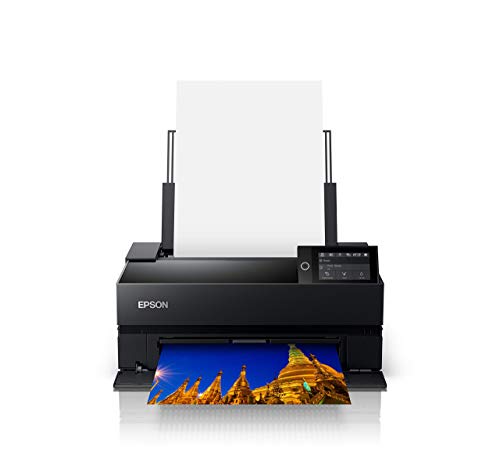
2. Epson SureColor P700 — Best Pigment Printer Under 13 Inches
The Epson SureColor P700 is the printer serious fine art photographers and artists reach for when archival quality is non-negotiable. It uses Epson's UltraChrome PRO10 ink set with a dedicated Violet ink channel, producing an exceptionally wide color gamut that captures subtle tonal transitions most printers simply miss. The violet ink in particular extends the range into blues and purples that other 10-ink systems can't reproduce, which is a genuine advantage for landscape photography and abstract art prints.
One of the P700's standout engineering decisions is the elimination of Photo Black and Matte Black ink switching. Traditional wide-format printers waste ink and time swapping between these two black inks depending on your media type. The P700 has dedicated nozzles for both, so you can jump from glossy photo paper to watercolor rag stock without waiting or wasting a drop. The 10-channel MicroPiezo AMC printhead delivers exceptional consistency across long print runs — the hundredth print looks identical to the first.
At 13 inches wide, the P700 handles the same maximum paper size as the Canon PRO-200S, but with pigment inks that deliver dramatically better fade resistance. Prints on quality media can last 200+ years under proper display conditions, according to independent testing standards for giclée printing. If you're selling art prints or need gallery-grade permanence, the P700 is the smart investment.
Pros:
- UltraChrome PRO10 pigment inks with Violet channel for exceptional color gamut
- No black ink switching — saves time and ink when alternating media types
- Outstanding archival longevity (200+ years on select papers)
- Consistent output across long print runs thanks to AMC printhead
Cons:
- Higher ink costs than dye-based alternatives
- Glossy prints lack the immediate "pop" that dye inks deliver
3. Canon imagePROGRAF PRO-300 — Best for Fine Art Paper Handling
Canon's imagePROGRAF PRO-300 is a pigment-based 13" wide-format printer that competes directly with the Epson P700 — and in several areas, it pulls ahead. The PRO-300 uses a 10-color LUCIA PRO pigment ink system that includes dedicated Photo Cyan, Photo Magenta, and a Chroma Optimizer that smooths out the surface of prints to eliminate the bronzing and gloss differential issues that plague many pigment printers on glossy paper. The result is pigment-ink durability with a surface finish that approaches dye-ink smoothness.
Where the PRO-300 truly shines is in its paper handling and reliability. Canon's Nozzle Recovery System automatically detects and compensates for clogged nozzles without stopping your print — a feature that saves both time and expensive fine art paper. The Skew Correction system ensures perfect alignment even with thick, textured media like watercolor paper or canvas sheets. If you've ever lost an expensive sheet of Hahnemühle to a paper jam or misaligned feed, you'll appreciate how much engineering Canon put into the media path here.
The Professional Print & Layout software bundled with the PRO-300 gives you precise control over color management, soft proofing, and layout — it's genuinely useful, not just bundled filler. The 3.0" LCD screen and full wireless support round out a printer that's designed for artists who want professional results without a steep learning curve. For anyone building a home print studio, pairing this with a color-accurate monitor for photo editing creates a complete color-managed workflow from screen to print.
Pros:
- Chroma Optimizer eliminates bronzing and gloss differential on glossy media
- Nozzle Recovery System prevents failed prints from clogged heads
- Excellent paper handling with Skew Correction for thick fine art media
- Professional Print & Layout software included for advanced color management
Cons:
- Ink cartridges are small capacity — frequent replacements during heavy use
- Slower than the Canon PRO-200S for large format prints
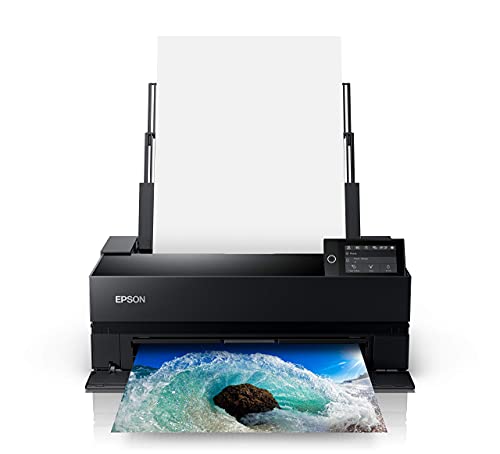
4. Epson SureColor P900 — Best 17-Inch Wide-Format for Serious Artists
If 13 inches isn't enough canvas for your work, the Epson SureColor P900 steps up to 17 inches of print width while keeping the same outstanding UltraChrome PRO10 ink technology found in the P700. This is the printer for artists creating large exhibition prints, poster-sized reproductions, or panoramic photographs that demand real visual presence on a gallery wall. The jump from 13" to 17" might sound modest on paper, but the difference in physical print area is dramatic — nearly twice the surface area when you go to 17" x 22".
The P900 shares the P700's no-switching dual black ink system and 10-channel MicroPiezo AMC printhead, so you get the same archival quality and consistency. The Violet ink channel continues to expand the color gamut into territory that 8-color systems can't reach. What the P900 adds beyond size is an improved media handling path that accommodates roll paper, giving you the ability to print panoramic or banner formats limited only by your paper length. For fine art photographers working with landscapes or artists creating triptych series, roll paper support is a game-changer.
The tradeoff is footprint and cost. The P900 takes up considerably more desk space than its 13" siblings, and both the printer and its ink cartridges carry a premium price tag. But if you're producing work for sale or exhibition at larger formats, the P900 eliminates the need to outsource to a print shop — and it pays for itself quickly when you're no longer spending $30-50 per large format print at a service bureau. If you also need large-format technical drawings, check out our guide to the best 11x17 printers for architects for more wide-format options.
Pros:
- 17-inch print width for large exhibition and gallery prints
- Same UltraChrome PRO10 ink set with Violet as the P700 — superb color gamut
- Roll paper support for panoramic and banner printing
- No Photo/Matte Black switching saves time and ink
Cons:
- Significantly larger footprint than 13" models
- Higher upfront cost and more expensive ink cartridges
5. Epson Expression Photo HD XP-15000 — Best Budget Wide-Format
Not everyone needs a $700+ professional printer. The Epson Expression Photo HD XP-15000 delivers borderless prints up to 13" x 19" at a fraction of the cost of the dedicated photo printers above, making it an excellent entry point for artists who want wide-format capability without the professional price tag. It uses a 6-color Claria Photo HD ink set that includes dedicated Red and Gray cartridges — the Red extends the warm color range while the Gray improves black-and-white tonal transitions and adds depth to shadow areas.
For the price, the XP-15000 punches well above its weight in color accuracy and detail. It won't match the archival permanence of pigment-based systems or the sheer color gamut of the 10-ink professional models, but for art prints displayed in homes, craft fairs, or online sales where prints are shipped and enjoyed rather than preserved for generations, it produces results that satisfy. The dual paper trays — including a rear specialty media feed — handle everything from regular photo paper to heavier cardstock without constant manual swapping.
The XP-15000 also functions as a capable everyday printer with front and rear trays, auto duplex, and Ethernet connectivity alongside Wi-Fi. If you need one printer that handles both your art printing and your household document needs, this is the pragmatic choice. The individual cartridges keep replacement costs reasonable, though high-volume art printing will run through ink faster than the occasional family photo.
Pros:
- Affordable entry into 13" x 19" borderless photo printing
- 6-color ink with Red and Gray for extended color range and better B&W prints
- Dual paper trays and auto duplex for versatile everyday use
- Compact design relative to dedicated professional wide-format printers
Cons:
- Dye-based ink with shorter archival life than pigment alternatives
- Smaller color gamut than 8 or 10-ink professional systems
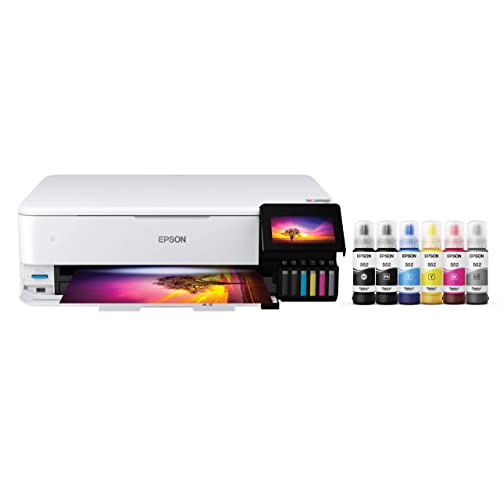
6. Epson EcoTank Photo ET-8550 — Best for High-Volume Art Printing
If you're printing art prints in volume — whether for an Etsy shop, craft fairs, or building inventory for gallery sales — the Epson EcoTank Photo ET-8550 changes the economics entirely. Its supertank ink system eliminates cartridges altogether, using refillable reservoirs that drop your per-print cost to roughly 4 cents for a 4" x 6" photo compared to 40 cents with traditional cartridges. When you're printing dozens or hundreds of art prints per month, that difference compounds into hundreds of dollars saved annually.
The ET-8550 uses 6-color Claria ET Premium inks and Epson's high-accuracy printhead to deliver lab-quality photos with vibrant colors and sharp detail. It handles borderless printing up to 13" x 19" and supports an impressive range of specialty media — cardstock, CD/DVDs, and papers up to 1.3mm thick. The 4.3-inch color touchscreen makes it one of the most user-friendly printers in this roundup, and the built-in scanner and copier add genuine utility beyond dedicated printing.
The all-in-one functionality means this is also a scanner and copier, which is valuable if you're digitizing original artwork for reproduction. A 4" x 6" photo prints in as fast as 15 seconds, making it the quickest on this list for small-format output. The higher upfront price compared to the XP-15000 is offset within months by the dramatically lower ink costs. For artists running a print-based business, the ET-8550 is the financially smart choice.
Pros:
- Supertank system slashes per-print costs — roughly 4 cents per 4x6 photo
- Borderless printing up to 13" x 19" with support for thick specialty media
- All-in-one with scanner/copier — useful for digitizing original artwork
- 4.3-inch color touchscreen and fast 15-second 4x6 output
Cons:
- Dye-based ink — not suitable for archival or museum-grade prints
- Higher upfront purchase price than cartridge-based alternatives
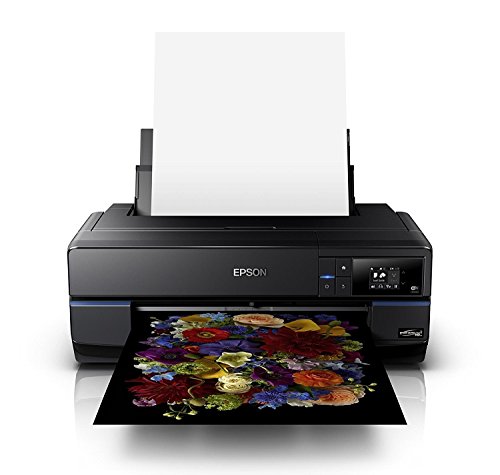
7. Epson SureColor P800 — Best Legacy Professional Choice
The Epson SureColor P800 is the predecessor to the P900, and while it's been on the market longer, it remains a formidable 17-inch wide-format printer that still commands respect in professional studios. It uses Epson UltraChrome HD inks — the generation before PRO10 — which deliver vivid color, superior black density, and significantly improved print longevity over consumer-grade inks. The maximum printable area reaches 17" x 129", making it capable of truly massive panoramic prints that the P900 can also achieve but at a higher price.
At 43 pounds and nearly 27 inches wide, the P800 is a substantial piece of equipment. It accepts cut sheets from a minimum of 3.5" x 5" up to a full 17" x 22", and the roll paper option opens up extended-length printing for murals, banners, or sequential art prints. The print quality on fine art papers is exceptional — the UltraChrome HD ink set handles both glossy and matte media with confidence, and the black density in particular gives shadow areas a richness that lower-end printers can't replicate.
The reason the P800 lands at number seven isn't quality — it's availability and value. As a legacy model, pricing can be erratic, and replacement ink cartridges may become harder to source as Epson shifts production toward the P900 line. If you find the P800 at a significant discount to the P900, it's an outstanding value. But buying at or near the P900's price doesn't make sense when the newer model offers better ink technology and improved reliability.
Pros:
- 17-inch print width with maximum 17" x 129" for panoramic prints
- UltraChrome HD pigment inks for excellent color and archival quality
- Proven, reliable platform trusted by professional photographers for years
- Potential for significant discounts as a legacy model
Cons:
- Older UltraChrome HD ink set lacks the Violet channel of PRO10
- Replacement ink and parts may become harder to find as production winds down
Choosing the Right Printer for Art Prints: A Buying Guide
Dye Ink vs. Pigment Ink: The Fundamental Decision
Every art print printer falls into one of two camps, and understanding the difference saves you from buyer's remorse. Dye-based inks (Canon PRO-200S, Epson XP-15000, Epson ET-8550) dissolve colorant directly into a liquid carrier, producing vibrant, saturated prints with smooth color transitions. They look stunning on glossy and semi-gloss papers. The downside is permanence — dye prints fade faster under light exposure, typically lasting 30-70 years under ideal display conditions.
Pigment-based inks (Epson P700, P800, P900, Canon PRO-300) suspend microscopic color particles in the liquid carrier. These particles sit on top of the paper surface rather than soaking in, which gives them dramatically better fade resistance — 200+ years on archival papers. The tradeoff is that pigment prints can exhibit bronzing (a metallic sheen at certain viewing angles on glossy paper) and sometimes look slightly less vibrant than dye prints on glossy media, though modern formulations have narrowed this gap significantly.
Your decision comes down to purpose. Selling prints that buyers will frame and display for decades? Go pigment. Printing vibrant reproductions for short-term display, craft sales, or personal enjoyment? Dye ink delivers more visual punch per dollar. For more context on choosing tools for your creative workflow, browse our art buying guide for additional recommendations.
Print Width: 13 Inches vs. 17 Inches
The 13-inch class printers (Canon PRO-200S, Epson P700, Canon PRO-300, Epson XP-15000, Epson ET-8550) handle paper up to 13" x 19" — that's an A3+ sheet. This covers the vast majority of art print needs including standard frame sizes up to 11" x 14" with bleed margins, and 13" x 19" for larger gallery pieces. These printers are also more compact, lighter, and more affordable both upfront and in ongoing ink costs.
The 17-inch class (Epson P900, Epson P800) opens up 17" x 22" and beyond with roll paper. If you're producing exhibition prints, selling large-format work, or creating poster-sized reproductions, 17 inches is the minimum practical width. Consider how you'll actually sell and display your work before investing in the larger format — many artists find that 13" x 19" covers 90% of their actual sales.
Color Gamut and Ink Channels
More ink colors generally translates to a wider printable color gamut and smoother tonal transitions. The 10-color systems (Epson P700/P900 with UltraChrome PRO10 and Canon PRO-300 with LUCIA PRO) deliver the widest gamut, with dedicated light and dark versions of primary colors plus specialty inks like Violet or Chroma Optimizer. The 8-color Canon PRO-200S sits in the middle with excellent results on glossy media. The 6-color systems (XP-15000 and ET-8550) are capable but show limitations in subtle color transitions, particularly in skin tones and sky gradients.
For fine art reproduction where you're matching original artwork colors as closely as possible, the 10-color systems are worth the premium. For general art printing where "vibrant and attractive" matters more than "exactly matches the original," 6-8 colors produce excellent results that most viewers won't distinguish from 10-color output at normal viewing distances.
Total Cost of Ownership
The purchase price is just the beginning. A $200 printer with expensive cartridges can cost more over two years than a $700 printer with cheaper ink. Calculate your expected monthly print volume and multiply by per-print ink cost to get a realistic total cost of ownership. The Epson ET-8550's supertank system wins decisively for high-volume printing — at roughly 4 cents per 4x6 photo versus 40 cents with traditional cartridges, the savings add up fast. Pigment ink printers like the P700 and PRO-300 have higher per-cartridge costs but also higher page yields.
Don't forget paper. Fine art media costs $1-3 per sheet for quality cotton rag or baryta papers. A failed print on a $3 sheet of Hahnemühle Photo Rag hurts your budget and your patience. Printers with better paper handling, nozzle checks, and alignment systems (like the Canon PRO-300's Nozzle Recovery) reduce waste and save money in the long run.
FAQs
What is the difference between giclée printing and regular photo printing?
Giclée (pronounced "zhee-clay") refers to high-quality inkjet prints made with archival pigment inks on fine art paper or canvas. The term typically implies the use of a professional-grade wide-format printer with at least 8 ink colors, printing at resolutions of 300 DPI or higher on acid-free media. Regular photo printing can use dye inks on standard photo paper. The key practical differences are longevity (giclée prints last 200+ years vs. 30-70 for dye prints), media quality (cotton rag, alpha cellulose, or canvas vs. resin-coated photo paper), and perceived value in the art market. Any of the pigment-based printers in this guide — the Epson P700, P900, P800, or Canon PRO-300 — are capable of producing gallery-quality giclée prints.
Can I use third-party ink in these printers for art prints?
Technically yes, but we strongly recommend against it for art printing. Third-party inks void your warranty, risk clogging the printhead (a repair that often costs more than a new printer), and produce inconsistent color profiles that undermine the entire point of investing in a quality art printer. The color accuracy and archival ratings published by manufacturers apply only to their own inks. For casual printing, third-party ink is a reasonable cost-saving measure. For art prints you're selling or displaying, use genuine manufacturer inks — the quality difference is real and measurable.
Do I need a color-calibrated monitor to make quality art prints?
You don't strictly need one, but you'll waste far less paper and ink with a calibrated display. Without monitor calibration, what you see on screen won't match what comes out of the printer — colors shift, brightness changes, and you end up reprinting to compensate. A hardware calibrator like the Calibrite ColorChecker Display costs around $150 and pays for itself in saved paper and ink within months. At minimum, use your printer's built-in ICC profiles and soft-proofing in your editing software to preview how prints will look before committing expensive media.
What paper weight and type is best for art prints?
For most art prints, look for cotton rag or alpha cellulose fine art papers in the 200-310 gsm (grams per square meter) range. Cotton rag papers like Hahnemühle Photo Rag (308 gsm) or Canson Infinity Rag Photographique (310 gsm) offer the best archival properties and a luxurious feel that buyers associate with quality. For photographic work, baryta papers provide a traditional darkroom-style finish with modern inkjet compatibility. Glossy and semi-gloss resin-coated papers work well for vibrant color reproduction but feel more like photographs than fine art. Always use paper that's explicitly rated for your ink type — pigment-compatible papers have a different coating than dye-compatible papers.
How large can I print before image quality degrades?
The maximum print size depends on your source image resolution. For sharp prints at normal viewing distance (about 18 inches), you need 300 DPI at print size. A 24-megapixel camera produces images of approximately 6000 x 4000 pixels, which prints at 20" x 13.3" at 300 DPI. For gallery prints viewed from several feet away, you can drop to 150-200 DPI without noticeable quality loss, effectively doubling your maximum print dimensions. Digital artwork created at 300 DPI at the target size will always print sharply. If you're upscaling smaller source images, AI-based upscalers like Topaz Gigapixel can produce clean enlargements up to about 4x before artifacts become visible.
Is it cheaper to print art prints at home or use a professional print service?
For occasional one-off prints, a print service is almost always cheaper. Professional labs charge $5-15 for a single 13x19 print on quality paper, and you avoid the upfront hardware investment. The math flips once you're printing regularly — at 20+ large prints per month, a home printer pays for itself within 3-6 months depending on the model. The Epson ET-8550 reaches break-even fastest thanks to its ultra-low ink costs. Beyond pure cost, home printing gives you complete control over color management, paper selection, and turnaround time — you can adjust and reprint instantly rather than waiting days for a service bureau. For most artists selling prints as part of their business, owning a capable printer is both more economical and more practical.
Buy on Walmart
- Canon PIXMA PRO-200S Professional 13" Wireless Inkjet Photo — Walmart Link
- Epson SureColor P700 13-Inch Printer,Black — Walmart Link
- Canon imagePROGRAF PRO-300 Wireless Color Wide-Format Printe — Walmart Link
- Epson SureColor P900 17-Inch Printer,Black — Walmart Link
- Epson Expression Photo HD XP-15000 Wireless Color Wide-Forma — Walmart Link
- Epson EcoTank Photo ET-8550 Wireless Wide-format Color All-i — Walmart Link
- Epson SureColor P800 17" Inkjet Color Printer,Black — Walmart Link
Buy on eBay
- Canon PIXMA PRO-200S Professional 13" Wireless Inkjet Photo — eBay Link
- Epson SureColor P700 13-Inch Printer,Black — eBay Link
- Canon imagePROGRAF PRO-300 Wireless Color Wide-Format Printe — eBay Link
- Epson SureColor P900 17-Inch Printer,Black — eBay Link
- Epson Expression Photo HD XP-15000 Wireless Color Wide-Forma — eBay Link
- Epson EcoTank Photo ET-8550 Wireless Wide-format Color All-i — eBay Link
- Epson SureColor P800 17" Inkjet Color Printer,Black — eBay Link
Match your ink type to your purpose — pigment for prints that outlast you, dye for prints that outshine everything on the wall today.


About David Fox
David Fox is an artist and writer whose work spans painting, photography, and art criticism. He created davidcharlesfox.com as a platform for exploring the history, theory, and practice of visual art — covering everything from Renaissance masters and modernist movements to contemporary works and the cultural context that shapes how art is made and received. At the site, he covers art history, architecture, anime art and culture, collecting guidance, and profiles of influential artists across centuries and movements.
Now get FREE Gifts. Or latest Free phones here.
Disable Ad block to reveal all the secrets. Once done, hit a button below